
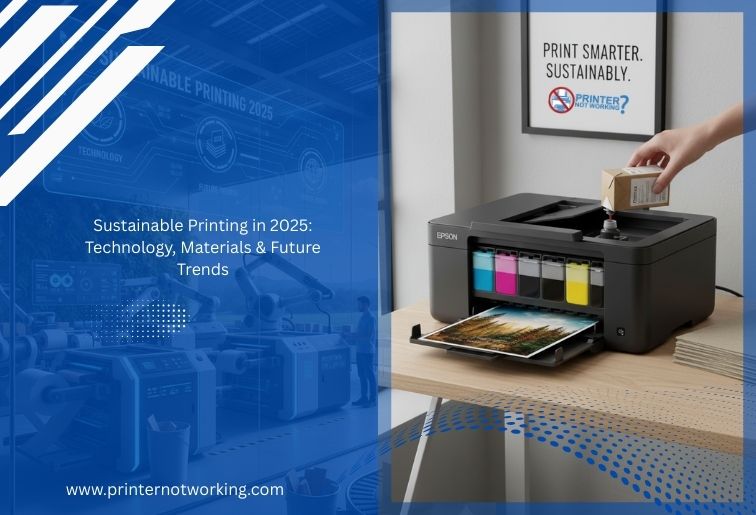
Printing has long been essential for businesses, education, manufacturing, design, and packaging—but it hasn’t always been friendly to the planet. High energy use, chemical-heavy inks, and excessive paper waste have historically made printing a sustainability challenge. But as we move deeper into a technology-driven decade, sustainable printing in 2025 is no longer an abstract idea—it’s a measurable, data-backed movement.
Organizations today are more conscious of environmental responsibility, and consumers are actively favouring brands that commit to sustainability. As a result, eco-friendly printing trends 2025 aren’t only about reducing waste; they’re about adopting smarter tools, cleaner materials, and circular processes that transform printing from an environmental burden into an eco-efficient workflow.
In this blog, we explore how technology, materials, and innovative systems are reshaping the next era of printing.
1. The Evolution of Sustainable Printing: Where We Stand in 2025
Sustainability isn’t new to printing, but the pace of innovation has accelerated dramatically. Several global factors—rising environmental regulations, access to greener technology, corporate ESG commitments, and material science breakthroughs—have all converged to shape what we now call sustainable printing in 2025.
Key Drivers Behind the Movement
- Corporate responsibility: More companies publishing sustainability reports.
- Regulations: Governments enforcing emissions and waste-reduction mandates.
- Technological upgrades: Smarter printers, IoT-enabled maintenance, and software optimization.
- Consumer demand: Eco-labels and green certifications influence purchasing decisions.
These elements directly impact how eco-friendly printing trends 2025 are unfolding.
2. Breakthrough Printing Technologies Transforming 2025
Technology sits at the heart of the sustainable printing revolution. In 2025, printers are not only more energy-efficient but also smarter and more resource-conscious.
2.1 Energy-Efficient Smart Printers
Modern printers consume significantly less energy thanks to:
- Low-temperature toner fusing
- Automatic sleep & power-cycle features
- AI-based energy consumption optimization
- Adaptive print queues that reduce waste
Many enterprise-grade devices now include real-time sustainability dashboards, helping teams track carbon savings and optimize print behaviour
2.2 Cloud & Serverless Printing
One of the biggest eco-friendly printing trends 2025 is the shift to cloud-native workflows. With fully digital print management:
- Unnecessary prints drop significantly
- Print authentication reduces accidental outputs
- Remote management eliminates on-site hardware needs
For businesses transitioning to hybrid work environments, cloud printing has become both eco-friendly and cost-effective.
2.3 Additive Manufacturing (3D Printing) Sustainability Upgrades
3D printing is undergoing its green transformation with:
- Plant-based filaments (corn, soy, algae bio-plastics)
- Recycled polymer blends
- Closed-loop material refill systems
- Energy-efficient sintering technologies
These innovations reduce environmental impact while enabling high-precision production.
3. Green Materials Defining Sustainable Printing in 2025
Materials are where sustainability becomes truly tangible. Replacing chemically laden inks and non-recyclable substrates has been a top priority—and 2025 marks a major leap in greener options.
3.1 Biodegradable & Plant-Based Inks
Traditional inks rely on petroleum-based solvents that release VOCs. In contrast, 2025 offers safer alternatives:
- Soy-based inks for packaging and commercial prints
- Algae inks with ultra-low carbon footprints
- Vegetable- and water-based inks replacing chemical-heavy variants
These inks degrade cleanly, provide high colour quality, and reduce emissions—making them a cornerstone of sustainable printing in 2025.
3.2 Recycled & FSC-Certified Paper Options
Paper continues to evolve with:
- 100% post-consumer waste (PCW) papers
- Tree-free paper (bamboo, hemp, sugarcane bagasse)
- FSC- and PEFC-certified substrates
- Improved durability and print finish
Both consumer and business markets are seeing rapid adoption due to regulatory pushes and corporate carbon reduction goals.
3.3 Compostable Packaging Substrates
One of the fastest-growing eco-friendly printing trends 2025 is compostable packaging. E-commerce, retail, and food industries now use:
- Plant-fiber packaging boards
- Compostable films for labels and wrappers
- Water-based adhesives
This shift aligns with the broader move toward circular product lifecycles.
4. Workflow Automation & AI: Reducing Waste Through Intelligence
AI has become a central element of printing workflows in 2025. It’s not just about producing prints—it’s about optimizing every step before, during, and after production.
How AI Supports Sustainable Printing
- Automatically adjusts color density to reduce ink usage
- Predictive maintenance reduces part failures and landfill waste
- Intelligent layout tools minimize misprints and errors
- Digital proofing eliminates unnecessary test prints
By embedding intelligence into printing ecosystems, businesses make sustainable printing in 2025 achievable at scale
5. Circular Printing Systems: Closing the Loop
Circularity is more than recycling—it’s a full lifecycle strategy. In 2025, circular printing models promote reuse, refill, and re-manufacturing.
5.1 Cartridge-Free Printing Systems
One of the biggest environmental wins is the rise of:
- Ink tank printers
- Cartridge-less laser systems
- High-capacity refillable reservoirs
These systems dramatically reduce plastic waste and transportation emissions.
5.2 Printer Refurbishment & Component Reuse
Manufacturers now offer:
- Certified pre-owned printers
- Component recycling programs
- Trade-in incentives for old machines
This extends product lifespans and reduces electronic waste.
5.3 Material Recovery Programs
From ink containers to printing substrates, recovery programs ensure all materials are reprocessed responsibly.
This circular approach is one of the most powerful eco-friendly printing trends 2025, helping large enterprises meet sustainability targets without compromising productivity.
6. Industry Spotlight: Sectors Leading Sustainable Printing in 2025
6.1 Packaging & Retail
Driven by consumer pressure and regulations, this sector adopts:
- Compostable labels
- Bio-based inks
- Low-energy digital presses
6.2 Education & Office Environments
Schools and organizations prioritize:
- Managed print services
- Cloud-based printing
- Low-waste devices
6.3 Manufacturing & Prototyping
3D printing innovations reduce:
- Material consumption
- Carbon footprint
- Supply chain waste
These sectors demonstrate how sustainable printing in 2025 is more than a trend—it’s a necessity.
7. Practical Steps for Businesses Adopting Sustainable Printing in 2025
Even small changes can have a major impact. Businesses today are embracing:
1. Switching to eco-friendly materials
Tree-free paper, biodegradable inks, and recycled substrates.
2. Upgrading to energy-efficient printers
Reduce electricity use and improve long-term productivity.
3. Implementing print management software
Cut waste, track metrics, and optimize processes.
4. Training employees
Eco-conscious behaviour leads to lower waste and better resource handling.
5. Partnering with certified green vendors
Choose suppliers with environmental certifications.
By applying these strategies, any organization can align with the top eco-friendly printing trends 2025.
8. The Future: What’s Next for Sustainable Printing Beyond 2025?
Emerging innovations point to an even greener future:
8.1 Carbon-Neutral Printing Facilities
Some companies are moving toward net-zero emissions through:
- On-site renewable energy
- Carbon offset partnerships
- Energy-smart automation
8.2 Fully Circular Print Ecosystems
Soon, every component—ink, substrate, hardware—may be part of a renewable loop.
8.3 AI-Driven Zero-Waste Workflows
AI could eliminate misprints entirely, saving billions of pages annually.
8.4 New Organic Materials
Scientists are exploring:
- Mycelium-based substrates
- Lab-grown pigments
- Ultra-biodegradable composites
The coming decade indicates that sustainability will be the defining factor of printing innovation.
Conclusion
As industries worldwide embrace eco-conscious practices, the role of sustainable printing in 2025 becomes increasingly crucial. From biodegradable inks and circular materials to AI-driven optimization and energy-efficient hardware, the printing landscape is undergoing a transformative shift. These developments make printing cleaner, smarter, and far more responsible.
The rise of eco-friendly printing trends 2025 shows that sustainability isn’t just a buzzword—it’s a practical, achievable pathway for organizations across sizes and sectors. Businesses that adopt these technologies today will lead the green printing revolution of tomorrow.